
Predicates (vị từ)
- Predicate (vị từ) là một biểu thức logic chứa biến, nói về tính chất (property) của biến đó
- Gán biểu thức predicate cho
, chưa rõ giá trị đúng/sai cho đến khi gán giá trị cụ thể cho biến đó. is called propositional function
Quantifier (lượng từ)
Universal quantifier (
- Universal quantification of a
is
- Notation
: - For every
- For all
- For each, for any, for arbitrary, …
- For every
Existential quantifier (
- Existential quantification of a
is
There exists an element x in a domain such that
- Notation
: - There is an x such that
- There is at least one x ….
- For some
- There is an x such that
The uniqueness quantifier (Skipped)

Precedence of Quantifier
- The quantifiers ∀ and ∃ have higher precedence than all logical operators from propositional calculus
Quantifier with restricted domain
- The restriction of universal quantification
is the same as the universal quantification of a conditional statement - The restriction of existential quantification is the same as the existential quantification of a conjunction
Logical Equivalences Involving Quantifiers
- Statements involving predicates and quantifiers are logically equivalent, if and only if they have the same true value, no matter:
- which predicates are substituted into
- which domain of discourse is used?
- Example:
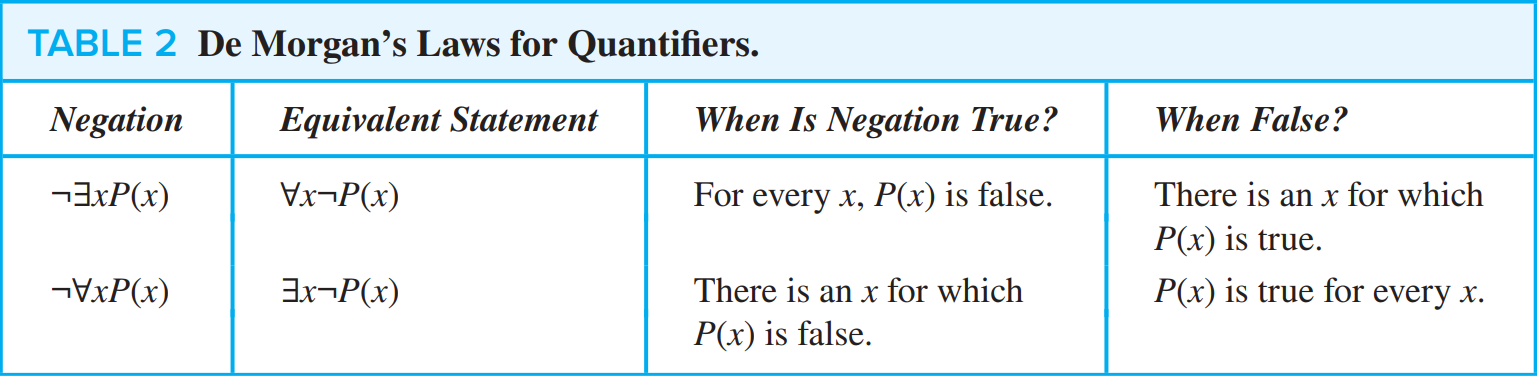
Negating Quantified Expressions
Nested Quantifiers
: for all real numbers x and y, x + y = y + x : For all real numbers x and y, if x is positive and y is negative, then the product of x and y is negative
INFO
Think of nested quantifiers like a 2 NESTED LOOP IN PROGRAMMING
The Order of Quantifiers
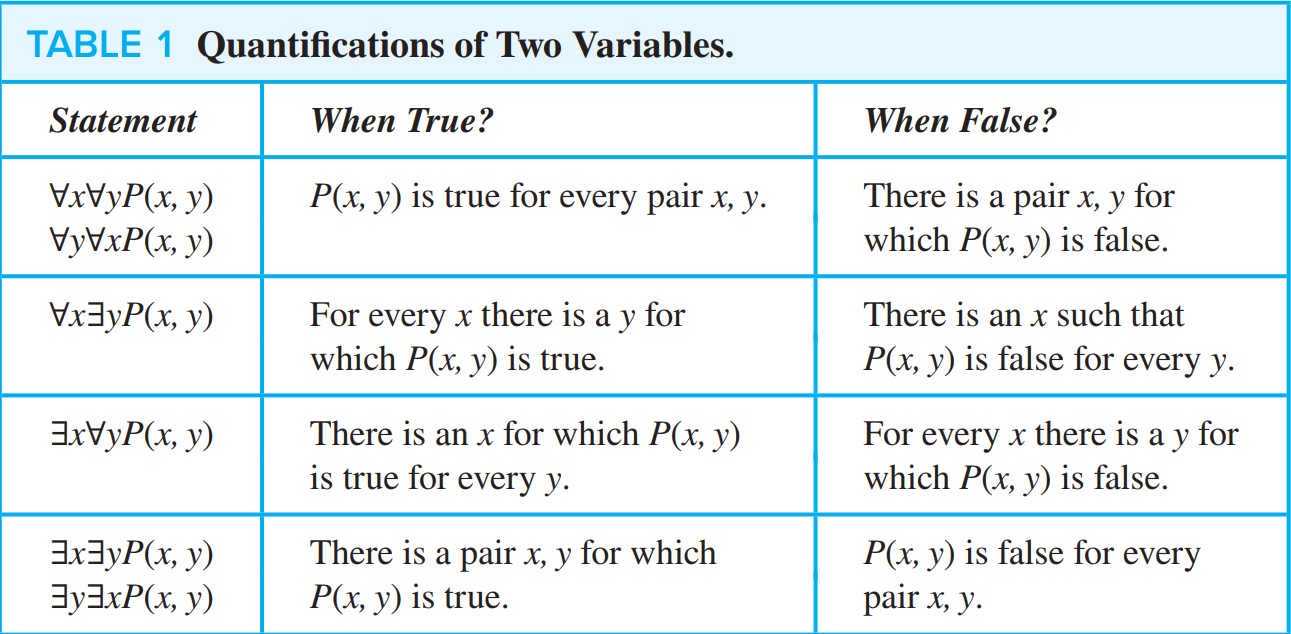
Negating nested quantifier
- Apply De Morgan’s Laws for negating, just apply from left → right in propositions
Quantifiers: at least, at most, exactly
Setup
Let P(x) be a predicate over a domain.
1. At least n
Meaning
There are at least n distinct elements satisfying P.
Form (example n = 2)
General pattern
- Use n existential quantifiers (∃)
- Add pairwise distinct conditions (≠)
2. At most n
Meaning
There are no more than n elements satisfying P.
Form (example n = 1)
Form (example n = 2)
General pattern
- Use universal quantifiers (∀)
- If n+1 elements satisfy P → at least two must be equal
3. Exactly n
Meaning
There are exactly n elements satisfying P.
Form
TIP
(at least n)
Example: Exactly 2
Special case: Exactly 1 (unique existence)
Quick cheat sheet
- at least n ->
distinct elements - at most n -> not exist
distinct elements - exactly n -> (≥ n)
(≤ n)