
Definition
- A set is an unordered collection of distinct objects, called elements or members of the set.
- We write
to denote that a is an element of the . - The notation
denotes that a is not an element of the .
Representation
Enumerate
Set builder
Venn Diagrams
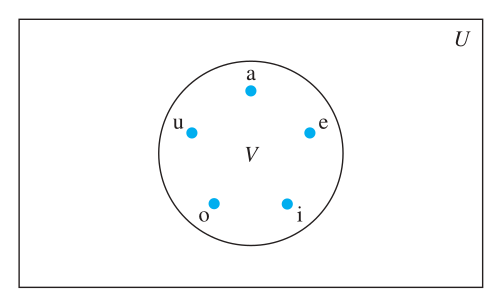
Set Equality
- Two sets are equal if and only if they have the same elements.
- We write
if A and B are equal sets. - Therefore, if A and B are sets, then A and B are equal if and only if
TIP
To show that two sets A and B are equal, show that
Empty set
- Empty set (null set): a special set that has no elements
- Notation:
- Example: the set of all positive integers that are greater than their squares is the null set
Singleton set
- Singleton set: A set with one element is called a singleton set
- Example:
has one more element than
Subsets
- The set A is a subset of B, and B is a superset of A, if and only if every element of A is also an element of B.
- We use the notation
to indicate that A is a subset of the set B. - If, instead, we want to stress that B is a superset of A, we use the equivalent notation
- We see that A ⊆ B if and only if the quantification:
Proper subset
- That a set A is a subset of a set B but that
- That is, A is a proper subset of B if and only if
Theorem 1
- Proof: We will prove (i )
- Let S be a set.
- To show that
, we must show that: is true.
- Because the empty set contains no elements, it follows that
is always false. - It follows that the conditional statement
is always true, because its hypothes is always false and a conditional statement with a false hypothesis is true. - Note that this is an example of a vacuous proof.
The Size of a Set
- Let S be a set. If there are exactly n distinct elements in S where n is a non-negative integer,
- we say that S is a finite set and that n is the cardinality of S.
- The cardinality of S is denoted by
Power Sets
- Given a set S, the power set of S is the set of all subsets of the set S.
- The power set of S is denoted by
- Example: The power set
is the set of all subsets of . Hence,
Cartesian Products
Ordered n-tuples
- The ordered n-tuple
is the ordered collection that has as its first element, as its second element, … , and as its nth element. - Let A and B be sets. The Cartesian product of A and B, denoted by
, is the set of all ordered pairs (a, b), where a ∈ A and b ∈ B. - Hence,
WARNING
Note that the Cartesian products A × B and B × A are not equal unless
Generally for product of multiple sets
- We denote
, is the set of ordered n-tuples , where belongs to for i = 1, 2, … , n. - In other words,
Using Set Notation with Quantifiers
- We restrict the domain of a quantified statement explicitly by making use of a particular notation
- denotes the universal quantification of P(x) over all elements in the set S
- Ex:
Truth Sets and Quantifiers
- We will now tie together concepts from set theory and from predicate logic.
- Given a predicate P, and a domain D, we define the truth set of P to be the set of elements x in D for which P(x) is true.
- The truth set of P(x) is denoted by
What are the truth sets of the predicates P(x) where the domain is the set of integers and P(x) is “|x| = 1,” . ⇒ The truth set of P,
, we see that the truth set of P is the set Note that
is true over the domain U if and only if the truth set of P is the set U. Likewise,
is true over the domain U if and only if the truth set of P is nonempty.