
INFO
Tính chia hết và số học đồng dư
Division
- For 2 integers a and b, a ≠ 0, a divides b
if it exists an integer k such that - Express using quantifier
- a is a factor or divisor of b (a là uớc, số chia của b)
- b is a multiple of a (b là bội của a)
Theorem 1
- Let a, b, and c be integers, where a ≠ 0. Then,
👆
if
👆
if
🥉
if
Corollary 1
👉
If a, b, and c are integers, where a ≠ 0, such that
Theorem 2 (Division algorithm)
👉
Let a be an integer and d a positive integer.
Then there are unique integers q and r, with
- In the equality:
- d is called the divisor (số chia)
- a is called dividend (số bị chia)
- q is called quotient (thương)
- r is called remainder (số dư)
- We have notation for q and r:
Modular Arithmetic (số học đồng dư)
Congruent (đồng dư thức)
- If a and b are integers and m is a positive integer, then a is congruent to b modulo m if m divides a − b
- m is called modulus (plural moduli) - mẫu số đồng dư
Theorem 3
👉
Let a and b be integers, and let m be a positive integer. Then
- Proof,
Theorem 4
👉
Let m be a positive integer. The integers a and b are congruent modulo m if and only if there is an integer k such that
- Proof, use direct proof from the definition of congruence
Theorem 5
- Let m be a positive integer. If
and , then - Proof, direct proof
Corollary 2
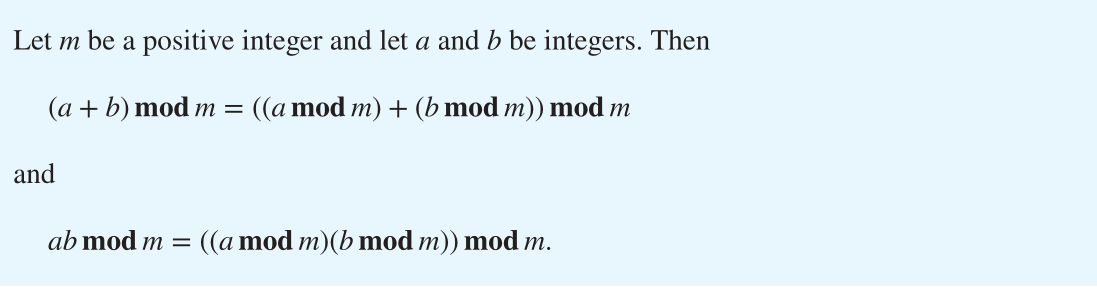
Arithmetic Modulo m
Definition
- We can define arithmetic operations on
, the set of non-negative integers less than m, that is, the set . - In particular, we define the addition of these integers, denoted by
(use + for simplicity) by
- They also satisfy many of the same properties of ordinary addition and multiplication of integers.
- In particular, they satisfy these properties:
Properties
- Closure (Tính đóng)
- Associativity (Tính kết hợp)
- Commutativity (Tính giao hoán)
- Identity elements (Phần tử đơn vị)
👉
The elements 0 and 1 are identity elements for addition and multiplication modulo m, respectively
- Additive inverses (Phần tử đối), not be applied for multiplicative
- Distributivity (phân phối)