
Equivalent Relations
Def
A relation on a set A is called an equivalence relation if it is reflexive, symmetric, and transitive.
- Two elements
and that are related by an equivalence relation are called equivalent. - The notation
is often used to denote that and are equivalent elements with respect to a particular equivalence relation.
Equivalence Classes
Let
INFO
The equivalence class of an element
The equivalence class of
If only one equivalence relation is being discussed, we usually write:
instead of
Definition
The equivalence class of
or equivalently:
Representative
If:
then representative of the equivalence class.
TIP
Any element in the class can serve as a representative.
TIP
There is nothing special about the chosen representative.
Equivalence Classes and Partitions
Let
These statements for elements equivalent
INFO
Partitions
Let equivalence relation on a set equivalence classes of
In other words, A partition of a set
such that:
Nonempty
Each subset is nonempty:
for all
Pairwise Disjoint
Different subsets do not overlap:
whenever
Cover the Entire Set
The union of all subsets equals the whole set:
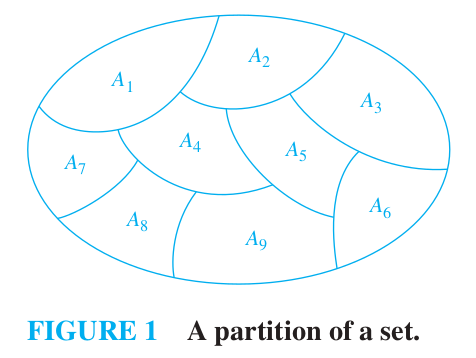
Equivalence Partitions and Relations
Theorem 2
Let
be an equivalence relationon a set. Then the equivalence classesofform a partitionof. Conversely, given a partition
of the set , there is an equivalence relationthat has the sets , , as its equivalence classes.